
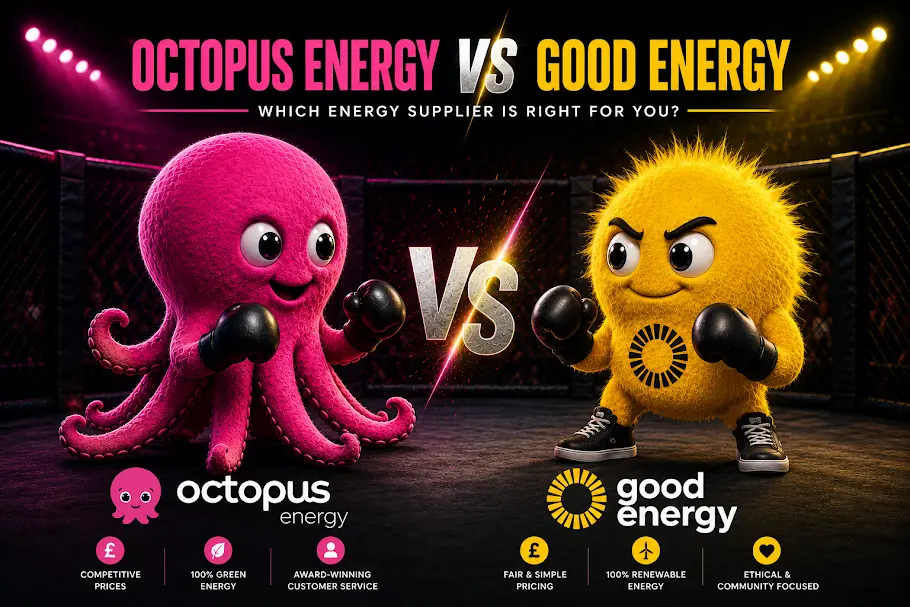
Octopus combines below-cap standard pricing with dynamic tariffs for EVs, batteries and heat pumps. Good Energy focuses on buying renewable electricity directly from independent British generators and offers specialist EV, heat-pump and solar products.
Table of Contents
Quick answer
Octopus Energy is the better overall choice for most households, particularly those looking for price-cap-protected standard pricing, smart tariffs, automated EV charging, heat-pump flexibility and advanced home-energy tools. It also holds a slightly higher recent Citizens Advice customer-service score.
Good Energy is the stronger option for customers who prioritise directly sourced 100% renewable electricity, support for independent British generators and attractive solar-export rates for qualifying installations. Neither supplier is guaranteed to be cheaper, so compare live quotes using the same postcode, consumption and payment method.
Quick Comparison: Octopus Energy vs Good Energy
Feature | Octopus Energy | Good Energy | Better Choice |
Standard variable pricing | Flexible Octopus stays below Ofgem’s cap | Standard tariff is exempt from the cap | Octopus |
Fixed tariff | 12-month fix with current exit fee | Good Energy Fix; terms vary | Compare quotes |
Smart tariffs | Agile, Tracker, Intelligent Go and Cosy | EV and heat-pump tariffs | Octopus |
Electricity mix | 86.4% renewable, 13.6% nuclear | 100% renewable | Good Energy |
EV charging | 8p/kWh for six cheap hours | 8p/kWh for five hours | Octopus |
Heat-pump tariff | Eight cheap hours daily | Seven cheap hours daily | Octopus |
Customer service | 3.67/5, ranked fourth | 3.49/5, ranked sixth | Octopus |
Standard solar export | 12p/kWh | 12p/kWh | Tie |
Highest export rate | 16p/kWh at peak time | 25p/kWh for eligible installs | Good Energy |
Digital experience | Advanced controls and rewards | Usage tools and installations | Octopus |
Best for | Smart homes and flexible pricing | Direct renewable sourcing | Depends |
Octopus Energy vs Good Energy—Detailed Comparison
Choosing between Octopus Energy and Good Energy involves more than comparing headline prices. Below, we assess their tariffs, renewable credentials, EV and heat-pump plans, solar export rates, customer service and digital tools to identify which supplier offers better value for different households.
1. Which Supplier Has Better Energy Prices?
Octopus Energy is usually stronger for standard pricing because Flexible Octopus is protected by Ofgem’s price cap and priced below it. Good Energy Standard is exempt because it provides additional support to renewable generators, so its prices may be higher or lower than the regulated benchmark.
From 1 July to 30 September 2026, Ofgem’s price cap represents an estimated annual bill of £1,663 for a typical dual-fuel household paying by Direct Debit under the revised consumption benchmark. Average capped rates are 26.11p/kWh for electricity and 7.33p/kWh for gas, with daily standing charges of 57.19p and 29.04p respectively. This is not a maximum bill, as total costs depend on usage.
Flexible Octopus has no exit fee. Octopus also offers fixed tariffs, but prices and exit fees can change, so customers should check a current postcode-based quote rather than relying on an earlier national estimate.
Good Energy Standard supports more than 3,300 independent renewable generators through direct, longer-term purchasing. Its price-cap exemption reflects the additional costs of this model.
Pricing verdict: Octopus is likely to suit price-focused households, while Good Energy may appeal to customers who prioritise direct support for renewable generators.
2. Who Offers Better Fixed, Tracker and Smart Tariffs?
Octopus wins for tariff variety. It offers standard fixed and flexible plans alongside daily Tracker pricing, half-hourly Agile rates and specialist tariffs for EVs, heat pumps and batteries. Good Energy’s smaller range is easier to understand but mainly covers standard, fixed, EV and heat-pump products.
Octopus Tracker changes electricity and gas prices daily using a published wholesale formula. It has no exit fee, although customers leaving during a term may wait nine months before rejoining. Its maximum prices are much higher than Ofgem’s cap, so it is unsuitable for households unable to tolerate short-term increases.
Agile Octopus publishes half-hourly electricity rates for the following day. Prices can become negative but can also rise to 100p/kWh, making it most suitable for homes that can automate batteries, EVs or appliances.
Good Energy currently lists Standard, Good Energy Fix, EV Charge and a Heat Pump tariff. Its smart plans require compatible meters sending half-hourly readings.
Tariff verdict: Octopus is better for flexible smart-energy users. Good Energy suits customers who want a simpler specialist tariff without wholesale-price exposure.
For another detailed smart-tariff comparison, read our Octopus Energy vs E.ON Next guide.
3. Which Supplier Is Greener?
Good Energy has the stronger renewable-electricity proposition. Its current fuel mix is entirely renewable and bought directly from more than 3,300 British generators, with an 88% half-hourly match between demand and renewable generation. Octopus reports zero-carbon electricity, but its mix includes nuclear power.
Good Energy’s April 2025–March 2026 mix is 55% wind, 27% biogeneration, 9% solar and 9% hydro, with reported operational emissions of 0g CO₂/kWh. Its greener gas contains at least 10% biogas, with remaining customer-gas emissions offset through Gold Standard projects.
Octopus’s April 2024–March 2025 disclosure reports 86.4% renewable electricity and 13.6% nuclear, also producing a zero-carbon generation mix. Nuclear is low carbon but not renewable.
Some Octopus tariffs are described as 100% renewable through REGO matching. Good Energy differentiates itself through direct purchasing and real-time matching.
Green verdict: Good Energy wins for renewable purity and sourcing transparency. Octopus remains a strong low-carbon supplier with broader smart-energy innovation.
Customers mainly interested in renewable suppliers can also read our Good Energy vs Ecotricity comparison.
4. Which Supplier Is Better for EV Charging?
Octopus is better for most EV owners. Both suppliers advertise 8p/kWh, but Intelligent Octopus Go provides six guaranteed cheap household hours and can schedule additional eligible vehicle charging automatically. Good Energy provides five fixed overnight hours and requires customers to charge within that window.
Intelligent Octopus Go offers 8p/kWh smart charging for up to six hours daily. The whole home also receives the cheap rate from 11:30pm to 5:30am. Customers manage targets, schedules and urgent charging in the Octopus app.
Good Energy EV Charge costs 8p/kWh from midnight to 5am. Customers need an eligible EV and compatible smart meter and should compare its daytime rate.
EV verdict: Octopus wins through its longer window, automation and connected-charging tools. Good Energy suits drivers prioritising directly sourced renewable electricity.
EV drivers can explore another smart-charging comparison in our Octopus vs OVO Energy guide.
5. Which Supplier Is Better for Heat Pumps?
Octopus offers greater heat-pump flexibility. Cosy Octopus provides eight lower-priced hours across three daily periods and has no exit fee. Good Energy provides seven off-peak hours split between morning and afternoon, using a fixed-term structure with a £75 early-exit charge.
Cosy Octopus is available for homes with heat pumps, electric boilers or eligible electric heating, even when Octopus did not install the equipment. Fixed and flexible versions are available without exit fees.
Good Energy’s renewable heat-pump tariff offers cheaper electricity from 5am–9am and 1pm–4pm. It requires half-hourly smart-meter readings and normally lasts around 12 months.
Heat-pump verdict: Octopus wins for eight cheap hours and contract freedom. Good Energy suits customers who prefer predictable fixed pricing.
6. Who Has Better Customer Service?
Octopus has the higher Citizens Advice customer-service score, although both suppliers perform well. Octopus ranks fourth with stronger waiting-time and customer-commitment results. Good Energy ranks sixth and performs better for complaints, billing and metering.
| Citizens Advice measure | Octopus Energy | Good Energy |
| Overall score | 3.67/5 | 3.49/5 |
| Fewer complaints | 3.5/5 | 4.0/5 |
| Contact waiting time | 3.6/5 | 2.6/5 |
| Billing and metering | 3.4/5 | 4.0/5 |
| Customer commitments | 5.0/5 | 3.0/5 |
| Ranking | 4th | 6th |
The results cover January to March 2026; the next update is expected in September 2026.
Customer-service verdict: Octopus wins narrowly overall. Good Energy may suit customers prioritising billing accuracy.
7. Which Supplier Pays More for Solar Exports?
Good Energy offers the highest headline export payment, while Octopus provides more flexible options for existing solar-and-battery homes. Both pay 12p/kWh on straightforward standard products. Good Energy pays 25p/kWh for qualifying installations; Octopus offers peak-time and wholesale-linked plans.
Outgoing Octopus pays 12p/kWh. Prime Outgoing pays 16p/kWh from 4pm to 7pm and 9p/kWh at other times, while Agile Outgoing follows uncapped day-ahead wholesale rates.
Good Energy Solar Savings pays 12p/kWh to eligible supply customers. Solar Savings Exclusive pays 25p/kWh for 12 months when Good Energy installed qualifying panels and a battery, after which customers move to the standard tariff.
Solar verdict: Good Energy wins for the highest installation-linked rate. Octopus is better for existing battery owners who can optimize export times.
8. Which Supplier Has the Better App and Home-Energy Ecosystem?
Octopus has the more advanced digital ecosystem. Its app controls eligible EV charging, displays detailed usage, manages payments and supports smart tariffs. Good Energy’s app covers essential account functions, while its wider advantage is access to solar, battery, EV-charger and heat-pump installations.
Octopus customers can review usage charts, submit readings, manage payments, change tariffs and access Octoplus rewards. Smart-tariff users can also control connected charging.
Good Energy customers can view historic usage, readings, bills and payments. It also installs solar panels, batteries, heat pumps and EV chargers.
Digital verdict: Octopus wins for software and automation. Good Energy is competitive for customers who want their supplier to install low-carbon equipment.
Octopus Energy vs Good Energy: Pros and Cons
Both suppliers offer different advantages. The pros and cons below highlight where Octopus Energy and Good Energy perform well and where each may be less suitable.
| Supplier | Pros | Cons |
Octopus Energy | Below-cap flexible pricing; broad smart-tariff range; six-hour EV rate; flexible heat-pump plan; stronger overall service score; advanced export options | Dynamic tariffs can be volatile; standard mix includes nuclear; current fixes may have exit fees |
Good Energy | 100% renewable mix; direct generator purchasing; strong billing score; EV and heat-pump tariffs; export up to 25p/kWh; installation services | Standard tariff is cap-exempt; smaller smart range; shorter EV window; premium export has conditions |
Which Supplier Should You Choose?
Choose Octopus Energy if you:
Want competitive mainstream pricing, daily or half-hourly smart tariffs, automated EV charging, flexible solar and battery export options, or a heat-pump tariff designed around cheaper periods. Octopus is particularly suitable for households that can shift their electricity use and benefit from connected home-energy technology.
Choose Good Energy if you:
Prioritise directly sourced 100% renewable electricity, want to support independent British renewable generators, prefer greener gas, or need professional installation of solar panels, batteries, an EV charger or a heat pump.
Overall winner: Octopus Energy
Octopus Energy is the stronger all-round choice for pricing flexibility, smart tariffs, EV charging and digital energy management. Good Energy remains the better specialist option for households that place renewable sourcing and direct support for independent generators above finding the lowest possible tariff.
Neither supplier is guaranteed to be cheaper for every home. Compare live quotes using the same postcode, annual consumption, payment method and meter type before switching.
Final Verdict: Octopus Energy or Good Energy?
Octopus Energy is the better overall supplier for most households. It offers stronger standard pricing, a wider smart-tariff range, better EV and heat-pump flexibility, more export choices and the higher Citizens Advice score.
Good Energy is the better specialist renewable supplier. Its 100% renewable mix, direct relationships with more than 3,300 generators and 88% real-time matching provide clearer evidence of renewable sourcing.
Choose Octopus for price, technology and flexibility. Choose Good Energy when renewable sourcing and independent generation are the priorities. Request live quotes before switching.
Frequently Asked Questions
Below are the most frequently asked questions about Octopus Energy and Good Energy. These answers cover key areas such as pricing, renewable energy, customer service, EV tariffs, solar benefits and smart tariff options to help you understand which supplier may be the right choice.
Is Octopus Energy cheaper than Good Energy?
Octopus is usually more competitive because Flexible Octopus stays below Ofgem’s cap. Good Energy Standard is cap-exempt and may be higher or lower because it directly supports renewable generators.
Is Good Energy greener than Octopus Energy?
Good Energy uses 100% renewable electricity bought directly from British generators. Octopus reports 86.4% renewable electricity and 13.6% nuclear in its zero-carbon mix.
Which supplier has better customer service?
Octopus scored 3.67/5 and ranked fourth for January–March 2026. Good Energy scored 3.49/5 and ranked sixth, but performed better for complaints and billing.
Which supplier is better for an electric car?
Octopus is better overall. Intelligent Octopus Go provides six cheap hours at 8p/kWh and automated charging; Good Energy provides five hours at the same rate.
Which supplier is better for solar panels?
Good Energy offers up to 25p/kWh for qualifying installations. Octopus provides more flexible export options, including 12p flat pricing and 16p peak-time pricing.