
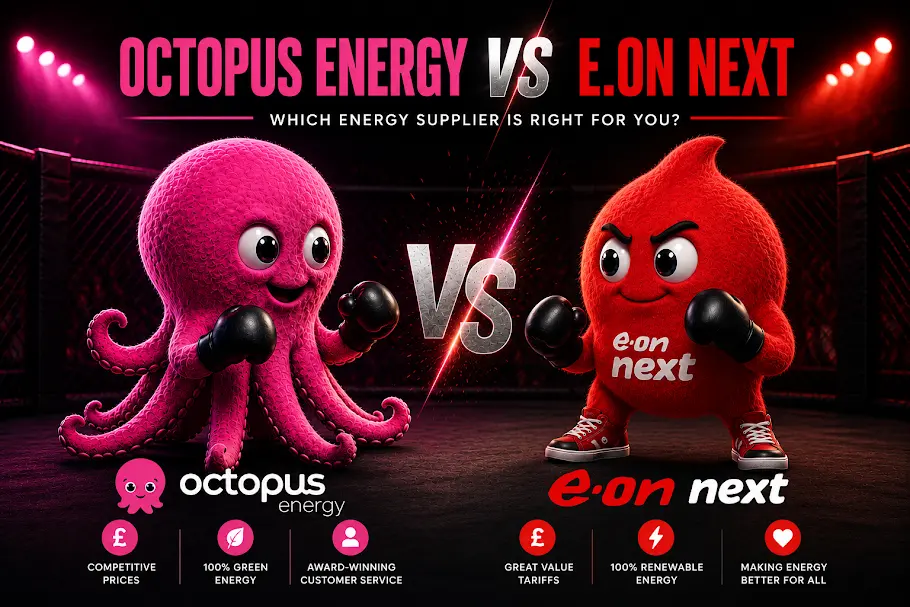
Choosing the right energy supplier in 2026 can help households save money and use energy more efficiently. Octopus Energy and E.ON Next are two leading UK suppliers, each offering different benefits. This comparison explores their tariffs, pricing, smart-energy features, customer service and overall value to help you decide which supplier is the better choice.
Table of Contents
Quick answer
Octopus Energy is the better overall choice for households that want smart tariffs, flexible pricing, EV integration and options designed for solar panels, batteries and heat pumps. E.ON Next is a strong alternative for customers who prefer conventional fixed tariffs, a price-cap tracker and faster complaint resolution.
Neither supplier is guaranteed to be cheaper for every home. Your actual cost depends on your postcode, annual consumption, payment method, meter type, current tariff and any smart technology you use.
For 1 July to 30 September 2026, Ofgem set the average energy price cap at £1,862 a year for a typical dual-fuel household paying by Direct Debit. The cap limits default-tariff unit rates and standing charges; it is not a maximum annual bill.
Octopus Energy vs E.ON Next at a Glance
Comparison area | Better option | Why? |
Overall | Octopus Energy | Broader smart-tariff ecosystem |
Cheapest | Depends | Personalized quotes vary |
Fixed tariffs | E.ON Next | Clear 12- and 24-month choices |
Dynamic tariffs | Octopus Energy | Daily and half-hourly pricing |
EV charging | Close result | Both advertise competitive smart charging |
Customer-service rating | E.ON Next, narrowly | Slightly higher Citizens Advice score |
Fewer complaints | Octopus Energy | Lower complaint volume |
| Faster complaint resolution | E.ON Next | Stronger resolution percentages |
| Renewable-tech ecosystem | Octopus Energy | Wider integration with EVs, solar and batteries |
Predictable budgeting | E.ON Next | Straightforward fixed and tracker products |
Choose Octopus Energy if you can shift your electricity use to cheaper periods, want automated EV charging, or have solar panels, a home battery or a heat pump.
Choose E.ON Next if you prefer a straightforward fixed tariff, want prices that remain below the Ofgem price cap, or value faster complaint resolution.
Octopus Energy vs E.ON Next—Detailed Comparison
Choosing between Octopus Energy and E.ON Next involves more than comparing headline prices. Below, we examine their tariff ranges, personalised costs, smart and EV tariffs, low-carbon products, customer service, complaint performance, digital tools and switching terms. Each section highlights the main differences and explains which supplier performs better for different household needs.
1. Which Supplier Offers the Better Tariff Range?
Octopus Energy Tariffs
Octopus offers several main tariff types:
- Flexible Octopus: a standard variable tariff.
- Fixed tariffs: rates fixed for a stated period.
- Octopus Tracker: gas and electricity prices change daily.
- Agile Octopus: electricity prices change every 30 minutes.
- Intelligent Octopus Go: automated EV charging.
- Octopus Flux: designed for solar and battery homes.
- Cosy Octopus: designed around heat-pump use.
Tracker can fall quickly when wholesale prices decline, but it can also rise sharply. Octopus currently caps Tracker’s maximum daily rate at 100p per kWh for electricity and 30p per kWh for gas. These limits are far above ordinary price-cap rates, so Tracker is unsuitable for customers who cannot tolerate sudden increases.
Agile gives customers access to half-hourly wholesale-linked electricity pricing. It is most useful when appliances, batteries or EV charging can be moved away from expensive periods.
E.ON Next Tariffs
E.ON Next currently promotes:
- Next Flex: standard variable tariff with no exit fee.
- Next Pledge: a 12-month tracker below the Ofgem price cap.
- Next Fixed 12m: one-year fix with a £50 exit fee per fuel.
- Next Fixed 24m: two-year fix with a £100 exit fee per fuel.
- Next Drive and Next Drive Smart: EV tariffs.
- Next Smart Saver: time-of-use electricity.
- Next Pumped: designed for heat pumps.
- Next Gust: backed by UK wind generation.
- Next Optimise: dynamic import and export for compatible batteries.
E.ON Next says Next Pledge saves an average dual-fuel household £50 against the price cap, although actual savings depend on usage.
Winner: Octopus Energy. E.ON Next has strong conventional options, but Octopus provides more choice for customers interested in daily or half-hourly prices.
To see how E.ON Next compares with another major supplier, read our E.ON Next vs OVO Energy comparison.
2. Is Octopus Energy Cheaper Than E.ON Next?
There is no universal winner. Prices can vary according to postcode, energy consumption, payment method, meter type, available fixed deals and smart-meter compatibility.
Do not compare suppliers using only an estimated annual bill. Compare electricity and gas unit rates, standing charges, exit fees and contract length using the same annual consumption for both quotes.
Flexible Octopus and Next Flex are variable tariffs. Their prices can change when wholesale conditions and price-cap periods change. Fixed tariffs provide more certainty, but customers may miss future price reductions and can face exit fees.
Octopus may be cheaper for a household that benefits from Tracker, Agile or an EV tariff. E.ON Next may offer a better fixed deal in a particular region. The reliable approach is to request quotes from both suppliers on the same day using identical details.
Winner: depends on your personalised quote.
3. Which Supplier Has Better Smart Tariffs?
Octopus has the clearest advantage in dynamic pricing.
Tracker changes electricity and gas rates daily. Agile changes electricity prices every half hour. These tariffs allow customers to respond faster to wholesale-market changes than conventional variable deals.
Lower prices are not guaranteed. Agile can be expensive during peak demand, and Tracker can rise when wholesale costs increase. They suit customers who understand the risk and can monitor or automate energy use.
E.ON Next does not offer a direct general equivalent to Agile, but it has useful time-of-use options. Next Smart Saver uses defined cheaper periods, Next Drive Smart manages EV charging, Next Pumped supports heat-pump use and Next Optimise manages compatible batteries.
E.ON’s fixed time bands may be easier to understand, but Octopus gives advanced users more control.
Winner: Octopus Energy.
4. Intelligent Octopus Go vs E.ON Next Drive Smart
Both suppliers offer competitive EV tariffs.
Intelligent Octopus Go advertises smart charging from 8p per kWh. It provides up to six off-peak hours each day and automatically schedules eligible charging when electricity is expected to be cheaper and often greener. A compatible vehicle or charger and a suitable smart meter are required.
E.ON Next Drive Smart also advertises 8p per kWh for the whole home from midnight to 6am. The same rate can apply during qualifying daytime smart-charging periods. It is fixed for 12 months and currently has no advertised exit fee. Customers need monthly Direct Debit, online account management, a compatible EV and half-hourly smart-meter data.
Feature | Intelligent Octopus Go | E.ON Next Drive Smart |
Advertised off-peak rate | From 8p/kWh | 8p/kWh |
Cheap period | Up to six hours daily | Midnight to 6am |
Automated charging | Yes | Yes |
Smart meter | Required | Required |
| Main strength | Flexible scheduling | Predictable overnight window |
Choose Octopus for deeper smart-energy integration. Choose E.ON Next when you prefer a fixed six-hour overnight period for the whole home.
Winner: close result.
5. Which Supplier Is Greener?
Both suppliers sell renewable-backed products, but green claims need context.
Electricity reaches homes through the shared National Grid. A renewable-backed tariff normally means that consumption is matched with qualifying renewable generation or certificates. It does not mean separate renewable electricity travels directly to one home.
Octopus has built its brand around renewable generation, flexible demand and low-carbon technology. Its tariffs connect EVs, batteries, solar panels and heat pumps with periods when electricity may be cheaper or easier for the grid to supply.
E.ON Next also offers renewable-backed tariffs. Next Gust is backed by electricity generated by UK wind assets, while Next Pumped includes renewable electricity and is designed for heat-pump customers.
Customers should read the exact tariff terms rather than assuming every product has the same environmental credentials.
Winner: Octopus Energy, narrowly, because of its broader renewable and smart-home ecosystem.
6. Which Supplier Has Better Customer Service?
Citizens Advice compares major domestic suppliers using complaints, contact waiting time, billing and metering, and customer commitments.
For January to March 2026, E.ON Next scored 3.71 out of 5, while Octopus Energy scored 3.67 out of 5. E.ON Next therefore ranked slightly higher overall.
The difference is small. E.ON Next has recently performed better for billing and metering, while Octopus has performed better for complaint volume.
Public-review websites can show common experiences, but ratings change frequently and do not use the same methodology as Citizens Advice. A balanced decision should consider independent ratings, formal complaint statistics and repeated customer-feedback themes.
Winner: E.ON Next, narrowly, based on the latest Citizens Advice score.
For another comparison involving Octopus, see our Octopus Energy vs Good Energy guide.
7. Which Supplier Receives Fewer Complaints?
The Q1 2026 complaint reports show a trade-off.
Octopus reported 538 complaints per 100,000 customer accounts. It resolved 43% by the same or next working day and 80% within eight weeks.
E.ON Next reported 757 complaints per 100,000 customers. It resolved 50.6% by the next working day and 90.5% within eight weeks.
Complaint measure | Octopus Energy | E.ON Next |
Complaints per 100,000 | 538 | 757 |
Resolved by next working day | 43% | 50.6% |
Resolved within eight weeks | 80% | 90.5% |
Octopus receives fewer complaints relative to its account base. E.ON Next resolves a greater proportion quickly.
Winner: Octopus for fewer complaints; E.ON Next for resolution speed.
8. Which Supplier Has the Better App and Online Experience?
Both suppliers allow customers to access bills, submit meter readings, manage payments and review account information online.
Octopus places more of its smart-energy experience inside its app and online account. Customers can monitor consumption, manage eligible tariffs and schedule Intelligent Octopus Go charging. This is useful for households combining an EV, battery or solar system.
E.ON Next also provides digital account management and specialist tools for connected home technology. The main difference is integration: customers using only ordinary billing features may see little difference, while households with several smart devices are more likely to benefit from Octopus’s ecosystem.
Winner: Octopus Energy.
9. Which Supplier Makes Switching Easier?
Switching should not interrupt the physical supply of gas or electricity. The pipes, cables and local network stay the same; the supplier responsible for billing changes.
Before switching, check your current exit fee, contract end date, new unit rates, standing charges, payment conditions, smart-meter compatibility and any EV or solar requirements.
Octopus customers can normally compare and change available tariffs through their online account, although specialist products can require extra eligibility checks.
E.ON Next presents the duration and exit fees of its main deals clearly. Next Flex has no exit fee; its current 12- and 24-month fixes carry fees of £50 and £100 per fuel, while Next Pledge carries £25 per fuel.
Citizens Advice recommends checking multiple comparison sources because different services may not display every supplier or tariff.
Winner: close result. Octopus offers a strong digital journey; E.ON Next clearly presents mainstream contract terms.
Which Supplier Is Best for Your Household?
Choose Octopus Energy when you:
- Own an EV and want automated charging
- Have solar panels or battery storage
- Can move usage outside peak periods
- Want daily or half-hourly pricing
- Prefer an integrated smart-energy ecosystem
- Value fewer complaints per 100,000 accounts
Choose E.ON Next when you:
- Want a conventional 12- or 24-month fix
- Prefer a tracker guaranteed below the price cap
- Value recent billing and metering performance
- Prefer faster complaint resolution
- Want a defined overnight EV period
- Are considering E.ON home-energy technology
Overall Winner: Octopus Energy
Octopus wins overall because it offers greater tariff innovation and more opportunities for flexible households to connect energy use with an EV, battery, solar system or heat pump.
E.ON Next remains a close competitor. It slightly leads the latest Citizens Advice score, resolves complaints more quickly and offers straightforward fixed and tracker tariffs.
The right decision depends on your household. Compare personalised quotes and read all product conditions before switching.
Pros and Cons Octopus VS E.ON
Both suppliers have clear strengths and limitations. The comparison below summarises the main advantages and disadvantages of Octopus Energy and E.ON Next to help you decide which one better suits your household.
Octopus Energy
Pros: broad smart-tariff range, daily and half-hourly pricing, strong EV and home-technology integration, and fewer complaints per 100,000 accounts.
Cons: smart tariffs can be complex, wholesale-linked rates can rise, and compatible meters or devices may be required.
E.ON Next
Pros: clear fixed choices, a below-cap tracker, slightly higher Citizens Advice score, faster complaint resolution and a competitive smart EV tariff.
Cons: more complaints per 100,000 customers, potentially significant fixed-tariff exit fees and less choice for daily or half-hourly wholesale pricing.
Final Conclusion
Octopus Energy is better overall for smart tariffs, EV charging, renewable technology and flexible energy use. E.ON Next is better for customers who prefer straightforward fixed deals, a below-cap tracker and faster complaint resolution.
Neither supplier is automatically cheaper. Use your actual annual consumption to compare unit rates, standing charges, exit fees and peak or off-peak periods.
Tariffs and prices can change quickly. Check both suppliers’ current quotations before entering a contract.
Frequently Asked Questions
Here are answers to the most frequently asked questions about Octopus Energy and E.ON Next. These FAQs cover common concerns about pricing, switching, smart tariffs, EV charging, complaints and smart meter requirements to help you make a more informed energy supplier choice in 2026.
Is Octopus Energy cheaper than E.ON Next?
Not always, Octopus may be cheaper for customers using smart tariffs, while E.ON Next may offer a better fixed deal in a particular region.
Which supplier is better overall?
Octopus is better overall for smart-energy users. E.ON Next may be better for conventional fixed tariffs and complaint resolution.
Should I switch from E.ON Next to Octopus?
Switch only when the new total cost and tariff features suit your household. Check exit fees, unit rates, standing charges and smart-device compatibility first.
Which supplier is better for EV owners?
Both have competitive smart EV products. Octopus is strong for automated scheduling, while E.ON Next offers a predictable midnight-to-6am period.
Which supplier receives fewer complaints?
Octopus received fewer complaints per 100,000 accounts in Q1 2026. E.ON Next resolved complaints faster.
Is Octopus Tracker always cheaper?
No, Tracker follows daily wholesale prices and can become expensive when the market rises.
Do smart tariffs require a smart meter?
Usually, yes. Tariffs using daily, half-hourly or automated charging data require a compatible smart meter.