Broadband is a requirement for the modern way of life. Even work and study with communication over the internet are not the only activities that use broadband nowadays. Other free-time activities, like watching TV shows and movies and playing games on the net, also require broadband. In the UK, your choice of broadband connection will determine a lot of your online experience results.
Here is a guide addressing different types of broadband that are available, their advantages, speeds, and how to choose the best type that will suit your needs. So, UK people, let’s learn about the best broadband options together.
Table of Contents
What is broadband?
Broadband is a high-speed internet connection that uses a wide range of frequencies to transmit multiple data signals at the same time. In simple terms, it allows fast downloading and uploading of data.
In the past, dial-up internet required a phone line connection, was very slow, and could not be used alongside phone calls. Broadband improved this by offering an “always-on” connection, using separate channels for data, so you can use the internet without interrupting your phone line.
Types of broadband connections
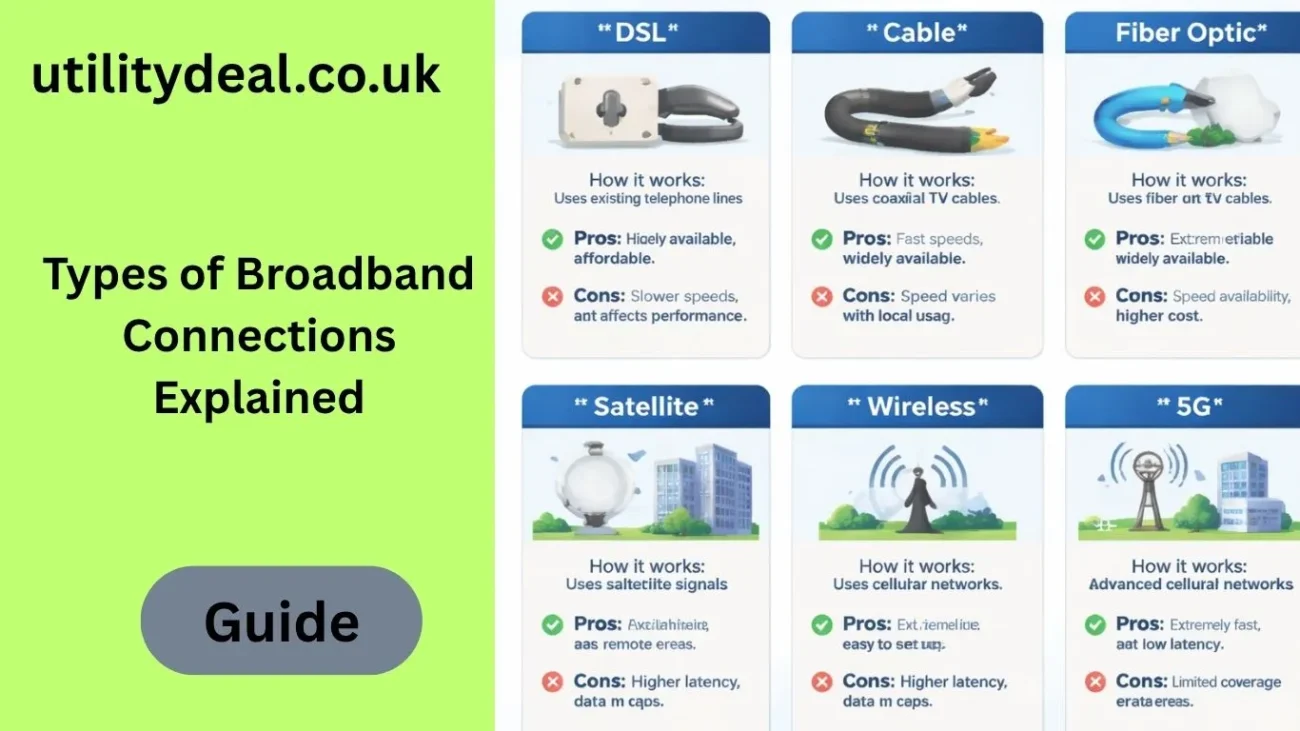
If you are looking to buy a new internet package, you will find different types of connections. Your local area’s infrastructure will determine what options you can buy. Below is an explanation of the main broadband technologies used across the country.
1.Full Fibre Broadband (FTTP)
Full Fibre broadband in the UK, also known as Fibre to the Premises (FTTP) or Fibre to the Home (FTTH), represents the gold standard of modern internet connections. In this setup, pure fiber-optic cables run directly from the internet exchange, straight into your home or office.
Fibre-optic cables use pulses of light to transmit data, which allows information to travel at incredibly high speeds without degrading over long distances. Typical speeds for full fibre range from 100 Mbps all the way up to 1 Gbps (1,000 Mbps) or more. This makes it the fastest and most reliable option currently available on the market.
Pros:
- It is entirely future-proof, easily handling the increasing data demands of modern technology.
- Outstanding for data-heavy tasks like competitive online gaming, downloading massive files, and streaming movies in 4K resolution.
- Highly reliable, as fibre cables are not affected by bad weather or electrical interference.
Cons:
- Availability is still growing, meaning it is not yet accessible in every neighborhood.
- It is generally the most expensive tier of internet service.
2. Part-Fibre Broadband (FTTC)
Part-Fibre broadband in the UK, or Fibre to the Cabinet (FTTC), is currently the most common type of connection for many households. Fibre-optic cables run from the telephone exchange to the green street cabinet in your neighbourhood. From that cabinet, traditional copper telephone wires carry the internet the rest of the way to your home.
Because copper wires are not as efficient at carrying data as fibre cables, the connection loses speed over that final distance. Part-fibre typically delivers speeds between 30 Mbps and 80 Mbps.
Pros:
- It is widely available across the vast majority of the country.
- Very affordable, offering a great middle-ground between price and performance.
- Fast enough to handle standard high-definition streaming and everyday browsing for a typical family.
Cons:
- Your actual internet speed will drop depending on how far your house is from the street cabinet.
- It is significantly slower than full fibre connections.
3. ADSL Broadband
Asymmetric Digital Subscriber Line, or ADSL broadband in the UK, operates entirely over the existing copper telephone network. The data travels from the telephone exchange all the way to your home using copper wires.
This is the oldest form of broadband technology still widely in use today. Speeds are considerably slower, typically maxing out at around 10 Mbps to 24 Mbps.
Pros:
- Because it uses the traditional phone network, ADSL is available almost everywhere, reaching over 99% of UK premises.
- It is usually the cheapest broadband option available.
Cons:
- It is an outdated technology that struggles to keep up with modern internet usage.
- Much slower than any fibre option, making it difficult for multiple people to stream or download simultaneously.
4. Cable Broadband
Cable broadband UK is uniquely delivered via a hybrid network of fibre-optic and coaxial cables. Providers like Virgin Media run fibre-optic cables to a street cabinet, but instead of using standard copper phone lines for the final stretch, they use high-grade coaxial cables.
Coaxial cables are designed to carry cable television signals and are much better at transmitting large amounts of data than standard telephone copper wires. This allows cable broadband to deliver exceptionally fast speeds, often matching full fibre by offering up to 1 Gbps.
Pros:
- Excellent for high-bandwidth activities, allowing large households to stream and game at the same time without lag.
- Does not require a traditional landline telephone connection.
Cons:
- The network is generally limited to specific providers.
- Speeds can occasionally suffer from network congestion during peak evening hours when everyone in the neighborhood is online.
5. Satellite Broadband
For people living in highly isolated locations, satellite broadband UK offers a vital lifeline. This technology beams the internet from satellites orbiting the Earth directly to a satellite dish installed on your property.
Speeds vary widely depending on the provider and the specific technology used, but they are generally slower than dedicated wired options.
Pros:
- It is available virtually anywhere, making it a perfect solution for extremely remote locations where laying cables is impossible.
- Provides internet access to homes completely disconnected from the national telephone network.
Cons:
- High latency (the delay in data traveling to space and back) makes fast-paced online gaming or video calling difficult.
- Heavy rain, snow, or severe storms can disrupt the signal and affect your connection speed.
- Installation often requires specialized equipment and professional setup.
6. Mobile Broadband (4G/5G)
Mobile broadband UK delivers internet access through the exact same cellular networks used by your smartphone. You can access this connection using a dedicated mobile WiFi router, a plug-in USB dongle, or a specialised data SIM card.
Speeds depend entirely on the cellular signal in your area. A strong 4G connection can comfortably reach speeds up to 100 Mbps. If you are in a 5G coverage area, those speeds can be substantially faster, sometimes rivalling or beating standard fixed-line broadband.
Pros:
- Highly portable and flexible. You can take your router with you on vacation or to a new apartment instantly.
- Quick setup with zero need for engineers or cable installations. Just plug it in and turn it on.
Cons:
- Many plans come with strict data caps, meaning you might have to pay extra if you download too much.
- Performance relies heavily on local mobile coverage, which can fluctuate.
7. Fixed Wireless Broadband
Fixed wireless broadband UK delivers internet access using radio signals rather than physical cables. A provider broadcasts a signal from a local transmission mast, which is then picked up by a small antenna attached to the outside of your property.
Speeds can vary dramatically depending on the provider’s equipment and your exact distance from the base station.
Pros:
- An excellent alternative for rural communities that lack modern wired infrastructure.
- Often provided by smaller, community-focused independent companies.
Cons:
- Requires a direct, unobstructed line of sight to the transmission mast. Trees, hills, or tall buildings can block the signal.
- Generally less reliable and slower than a dedicated full fibre connection.
Which type of broadband is best for you?
The decision of picking the right broadband provider for one’s home usage in the UK shouldn’t be based entirely on the number of options available on the market. It is imperative that you first understand your requirements.
Emailing and surfing the net only could be done with a very basic broadband connection, but if you have many people in your house, each using a computer, you will need something faster.
Broadband for Typical Home Users
First, if you are a normal home user, you should weigh your monthly budget and your typical internet usage, i.e., what you usually do on the internet daily. For instance, a small home that just looks at the internet and now and then uses Netflix will generally get along very well with a cheap part-fibre (FTTC, or Fibre to the Cabinet) package.
Broadband for Heavy Usage and Large Families
But a big family with teens who play online games, stream in 4K and download a lot of updates will find that going full fibre (FTTP) or cable broadband really helps them out.
Broadband for Business Users
Business users have different priorities. A loss of connection means a loss of revenue. Businesses should opt for reliable, high-speed broadband like full fibre. This ensures seamless video conferencing, rapid large data transfers, and the ability to support multiple employees accessing cloud-based software simultaneously.
Broadband for Rural Areas
For those living in rural areas, traditional cable and fibre options might simply not exist. In these cases, exploring mobile broadband, fixed wireless broadband, or satellite broadband may be your best bet to secure a functional and steady connection.
Common myths about broadband
Many people have misunderstandings about broadband due to its technical nature. These myths can lead to poor decisions when choosing an internet connection. Let’s clear up some of the most common broadband myths in the UK.
1.Faster Speed Is Always Better
Because internet technology is complex, several misunderstandings easily spread among consumers. Let us clear up a few common broadband myths UK residents frequently encounter. The first big myth is that “faster is always better”. People tend to be wowed by the highest speeds listed in spec sheets, but what they really need most of the time is more bandwidth, not speed per se.
Bandwidth refers to the amount of data capacity your internet connection has for several devices operating at the same time. Let’s say a family of four each wants to watch a show at the same time without any buffering that would require them to have good bandwidth. Whereas if you are a single person, then having a 1 Gbps connection is probably an exorbitant amount of money, as there is no way that you can use that much data by yourself.
2.ADSL Is Completely Outdated
Another myth that’s being thrown around a lot is “ADSL is old and useless everywhere.” Well, it’s a fact that ADSL is an old technology, but it is still very effectively used in some cases. For instance, in extremely remote locations where fibre is not yet available, a steady ADSL connection would be a good choice, even better than having no internet at all.
Also, the very basic ADSL internet will suffice for people who mainly use the internet to log on to Facebook and check their emails. Ultimately, ADSL is a very cheap solution.
3. Satellite Broadband Is Unreliable
Lastly, a lot of people think that “satellite broadband is totally unreliable”. Back in the day, satellite internet was painfully slow and quite annoying to use. But new technology involving low-Earth orbit satellites has really ramped up the speeds and made the service much more reliable.
Despite the fact that it is still a bit behind in latency when compared to fibre networks, it has changed completely from the slow, frequently disconnecting service of even 10 years ago.
Final Thought
Choosing a suitable broadband connection is an essential step towards a smooth and enjoyable online experience in the UK. You might want super-fast fibre internet for your streaming and gaming needs or a dependable mobile broadband that allows you to stay connected on the go.
The good news is that there are a lot of options to choose from depending on your needs and budget. Besides speed and availability, you should consider your usage requirements as well. To make a well-informed decision, comparing broadband providers and their packages is highly recommended.
If you learn more about Business Energy Guide please visit our website.
FAQS
With so many broadband options available, it can be tough to know which one is right for you. Here are answers to some common questions to help you choose the best broadband type for your needs.
Q1. How do I choose the right broadband?
Consider your internet speed requirements, data usage, and availability in your area. If you stream a lot of content or work from home, a faster broadband like Full Fibre is recommended. For general use, Part-Fibre (FTTC) or Mobile Broadband may be sufficient.
Q2. Can I get broadband in rural areas?
Yes, Satellite and Fixed Wireless broadband are great options for rural areas where fibre or cable might not be available.
Q3.Is ADSL broadband still available in the UK?
Yes, ADSL is still available in some areas, but it is slower and being phased out as fibre networks expand. It’s more suitable for light internet use, such as browsing and email.
Q4.Which broadband is the fastest in the UK?
Full Fibre (FTTP) broadband is the fastest, offering speeds up to 1 Gbps or more. It is ideal for heavy usage like 4K streaming, online gaming, and remote work.
Q5.Is mobile broadband good for home use?
Mobile Broadband (4G/5G) is great for portable internet use or as a backup connection. It’s ideal for people who need internet on the go, but it may not provide the reliability and speed needed for heavy usage at home.
