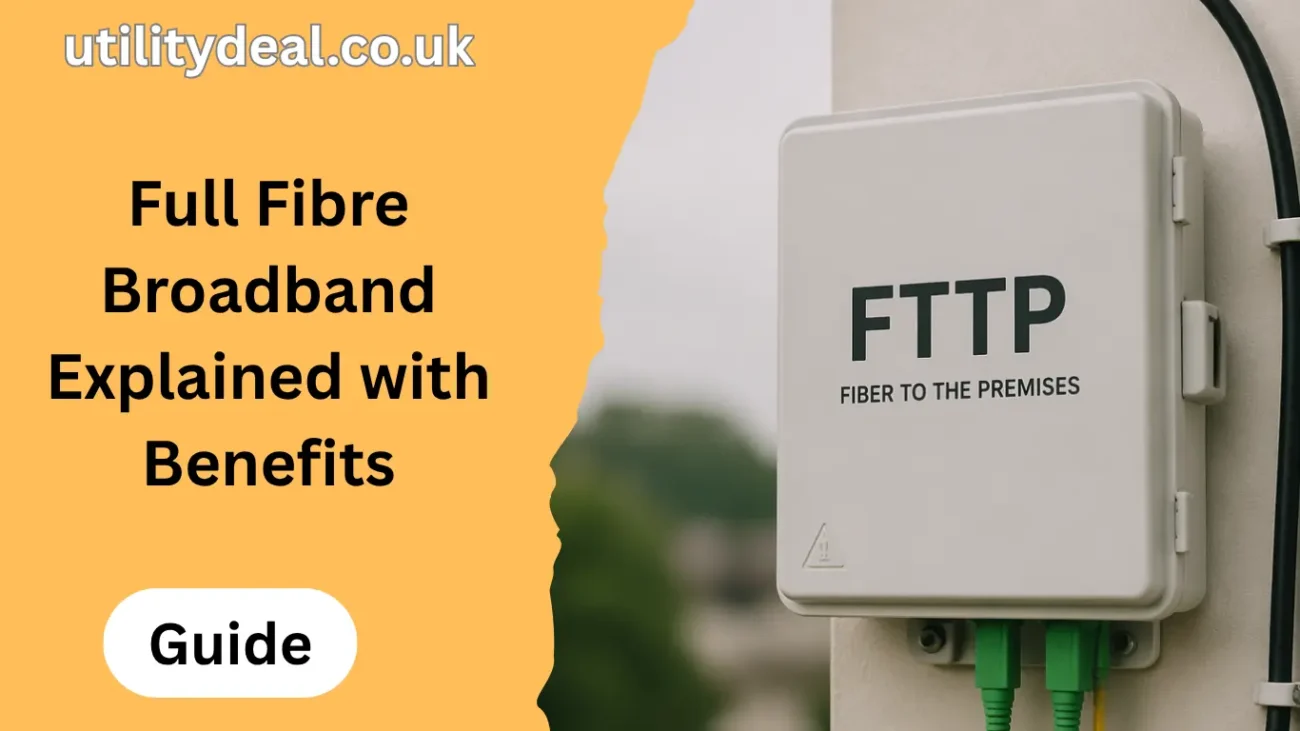
Nowadays a speedy and dependable internet is a must in the digital world. Full Fibre Broadband (FTTP) is completely changing the way we interact. It delivers super-fast internet through fibre optic cables laid straight to your home or business premise. In comparison to the traditional types of broadband, FTTP is a lot more dependable and offers a wider range of benefits and higher performance.
In this guide, we’ll explain what FTTP is, how it works, and why it’s the best choice for a modern internet connection.
Table of Contents
What is Full Fibre Broadband (FTTP)?
FTTP means “Fibre to the Premises”. This is one of the broadband service delivery methods where the fibre optic cables are laid from the internet exchange right up to the house or business.
In older networks, fibre cables are brought right up to a street cabinet, but from there the old copper wires are used to cover the last part of the distance to your home. It is this copper wire that drastically decreases the speed of data transmission. FTTP does away with copper completely. As a result, data can travel at the speed of light all the way from the source to your router.
Sometimes you may come across this technology being referred to by a few different names. FTTH or Fibre to the Home and full-fibre broadband are two of the common terms. But whatever the term, the digital infrastructure that they imply is basically the same.
How Does FTTP Work?
To understand how ultrafast internet reaches your devices, it helps to look at the technology inside the cables.
- Light signals: Data travels through fibre optic broadband cables using pulses of light. These thin strands of glass carry vast amounts of information almost instantly.
- Direct connection: The ISP sends the light signals from their exchange all the way to a small box installed inside your property.
- Router distribution: Your router then converts these light signals into the Wi-Fi network that your phones, computers, and smart TVs connect to.
This direct fibre line is vastly superior to older ADSL or FTTC setups. Because the connection uses light instead of electrical currents, it does not suffer from interference or signal degradation over long distances.
Full Fibre vs Other Broadband Types
Understanding the differences between broadband technologies can help you make an informed decision when upgrading.
FTTP vs FTTC (Fibre to the Cabinet)
Fibre to the Cabinet uses fibre optic cables to connect the local exchange to the green street cabinet. From there, old copper wires carry the internet to your house. This copper creates a massive bottleneck. FTTP uses full fibre the entire way, resulting in vastly better performance and reliability.
FTTP vs Standard Broadband (ADSL)
Standard broadband relies entirely on traditional copper phone lines. ADSL struggles to handle the demands of modern web use, offering very slow speeds. FTTP easily outperforms ADSL across every metric.
FTTP vs Wireless, Satellite, and 5G
Mobile broadband (like 5G) and satellite connections offer flexibility. However, they are highly susceptible to weather conditions, physical obstructions, and network congestion. FTTP provides a hardwired, stable connection with much lower latency.
Comparison Summary
Feature | FTTP | FTTC | ADSL |
Speed | 1 Gbps+ | Up to 80 Mbps | Up to 24 Mbps |
Reliability | Very High | Medium | Low |
Installation | 2-3 weeks | 1-2 weeks | 1 week |
Benefits OF FTTP
Upgrading to next-gen internet speeds offers numerous advantages. Here is what you can expect when you make the switch:
- Faster Internet Speeds: FTTP speeds routinely reach 1 Gbps (1,000 Mbps) or higher. You can download massive files or update large video games in minutes.
- Consistent Reliability: Fibre optic cables are immune to weather changes and electrical interference. Your connection remains stable at all hours of the day.
- Low Latency: A lower ping time creates a seamless experience for online gaming and crystal-clear video conferencing.
- Multiple Device Support: Busy households can stream 4K video, game online, and browse social media simultaneously without noticeable slowdowns.
- Future-Proofing: As technology demands grow, FTTP infrastructure is already equipped to handle the bandwidth requirements of tomorrow.
Full Fibre Coverage in the UK
Before upgrading, you should first verify whether fiber optic cables are already available in your street. Fibre to the Home (FTTH) nationwide roll-out in the UK is spreading at a fast pace. Both the government and private sectors are making big efforts to extend the fibre network to the residential sectors.
Urban areas generally have the highest availability. Cities and large towns often benefit from multiple network builders laying cables. Rural areas take longer to connect due to geographical challenges. However, specific rollout schemes aim to bring ultrafast internet to remote communities.
You can easily check your local availability using postcode checker tools on provider websites or independent comparison portals.
What to Expect During Full Fibre Broadband Installation
A full fibre broadband installation requires a bit more physical work than simply plugging in a new router. Here is a typical breakdown of the process:
- Engineer Visit: A technician must physically run the new fibre optic cable from the street to your property.
- Cable Routing: The engineer will drill a small hole in your exterior wall to feed the cable inside. They will then install a small box (an Optical Network Terminal, or ONT) on your interior wall.
- Timeframes: The physical installation usually takes between one to three hours. However, securing an appointment might take a few weeks from the moment you order.
- Preparation: Clear access to where the cable will enter your home. Ensure there is an accessible power socket nearby for the new ONT box.
How to Choose Among FTTP Broadband Providers
Numerous FTTP broadband providers operate across the market. Finding the best deal requires looking beyond just the advertised speed.
plying the highest or lowest speed tier for your monthly subscription price is not always a good idea if one uses the internet only for basic purposes. e.g. 150 Mbps is enough for an average user whereas 1 Gbps will be an overkill for one who mostly streams videos on Netflix and downloads only occasionally. Before making a final call, please scrutinize the contract length because some providers also tie you in for 18 to 24 months.
Examine the reputations of customer service and the kind of equipment supplied. A top-notch router is necessary to fully benefit from your upgraded speeds. Among well-known ISP in the UK are BT, Virgin Media, EE, and Sky. Also, don’t forget to see if there are any regional alternative networks (AltNets) around your locality because they usually offer very attractive prices.
Things to Consider Before Upgrading
Before committing to a new contract, weigh a few practical considerations.
Look at the monthly charges for FTTP versus your existing broadband bill. Typically, ultrafast internet is a little more expensive. Make sure that your activities on the net really warrant the additional cost.
Consider your landline telephone. Britain is gradually discontinuing the use of conventional copper phone lines. If you decide to convert to full fibre, then most probably your landline will become a Voice over Internet Protocol (VoIP) one. For using this type of phone, you are supposed to connect it straight to the rear of the new router, not to the wall jack.
Making the Switch to Next-Gen Broadband
Full Fibre Broadband (FTTP) is a giant step in improving digital connectivity. You get a very reliable and ultra-fast connection when you eliminate the obsolete copper wires and use the latest glass fiber ones.
If your house is always getting stuck in a buffer or your internet disconnection is a frequent event, look at the availability of service with your postcode. After that, review the speed tiers offered and the main providers in your area. Finally, book a visit for the installation. A home network upgrade will make you a hundred percent ready for the digital world of tomorrow.
Conclusion
In summary, Full Fibre Broadband (FTTP) is a great option for those seeking an internet service with faster speeds, better reliability, and one that is future-proofed. Given that increasingly more locations are being equipped with FTTP, it has become the preferred option for broadband users seeking a better experience. Be it working, entertainment or simply everyday use, with FTTP you get the high-speed internet connection that allows you to stay connected in a digital world.
For more detailed guides and the latest updates, explore our Business energy Guide .
FAQs
As Full Fibre Broadband (FTTP) becomes more popular, you might have questions about its benefits, installation, and availability. Here are some common questions to help you understand FTTP better.
Q1. How much does Full Fibre Broadband cost?
Pricing varies by provider, but FTTP plans generally offer competitive rates based on speed and contract length.
Q2. Can I upgrade my current broadband to FTTP?
Yes, if FTTP is available in your area, you can upgrade your existing broadband service to FTTP for faster speeds.
Q3. How fast is Full Fibre Broadband?
FTTP can offer speeds up to 1 Gbps or more, much faster than traditional broadband options like ADSL or FTTC.
Q4. Will FTTP work with my existing devices?
Yes, FTTP is compatible with most modern devices. However, to maximize speeds, you may need to upgrade your router to one that supports gigabit speeds.
Q5. Can I switch to FTTP if I already have fibre broadband?
Yes, if you’re on FTTC or another broadband type, upgrading to FTTP can provide significantly faster speeds and better overall performance.
