
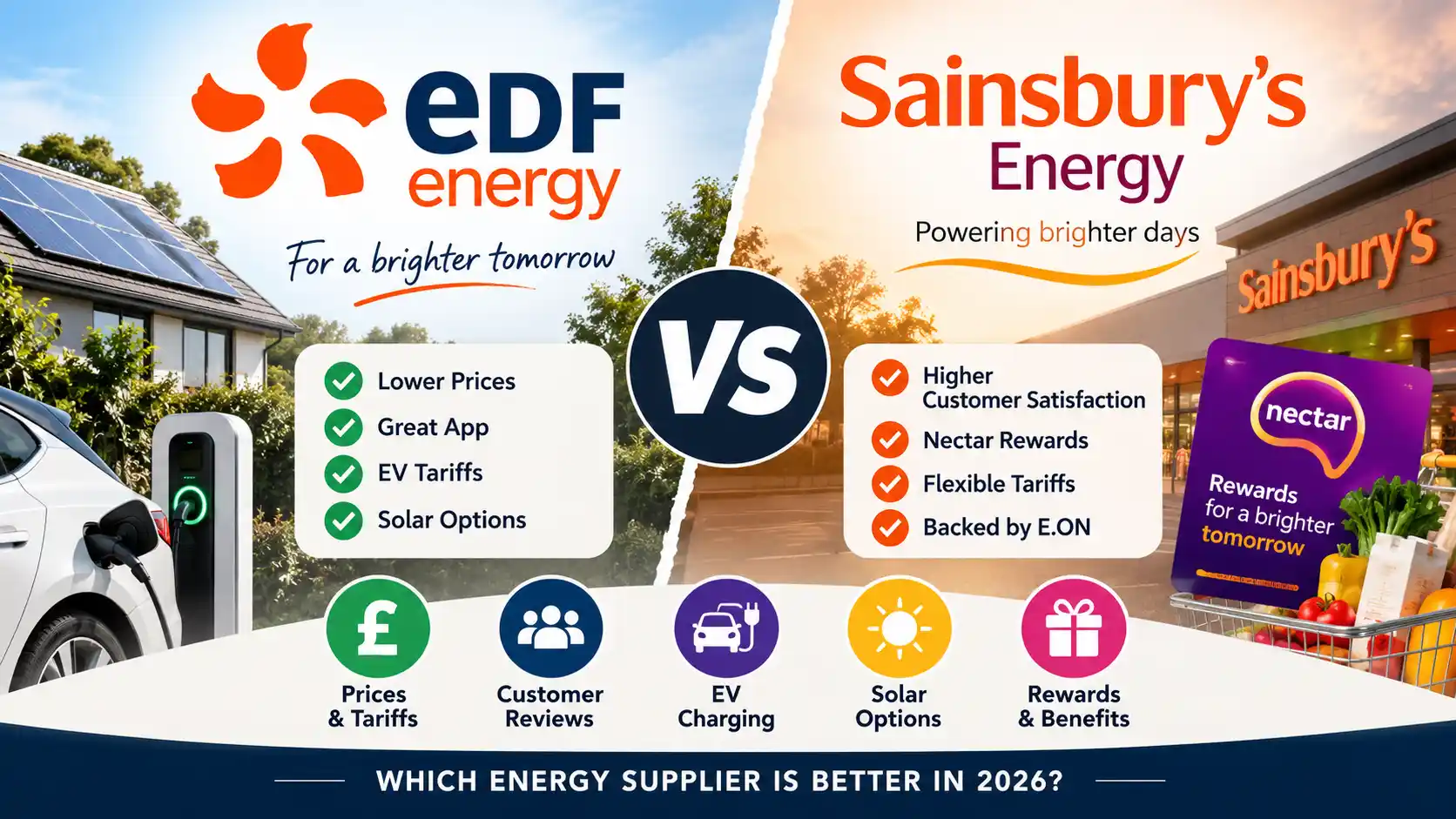
Our Verdict: EDF Energy — it offers cheaper tariffs and a rated, well-reviewed app, while Sainsbury’s Energy scores higher for customer satisfaction in the Which? survey.
Both suppliers offer solid value depending on what matters most to you — EDF Energy wins on price and app quality, while Sainsbury’s Energy leads on customer-service satisfaction and rewards.
About EDF Energy
EDF Energy is the UK retail arm of France’s state-owned Électricité de France, formed in 2002. It’s one of the UK’s largest suppliers and generates its own zero-carbon electricity through UK nuclear power stations. It won Silver for both Overall Customer Satisfaction and Customer Service at the 2025 Uswitch Energy Awards.
About Sainsbury’s Energy
Sainsbury’s Energy is a partnership between the supermarket chain and E.ON Next, which holds the supply licence and manages gas and electricity delivery. Its key differentiator is the Nectar rewards scheme, letting customers earn points on both their energy bills and shopping. It was named a Which? Recommended Provider for 2026.
| Key comparison | EDF Energy | Sainsbury’s Energy |
| Trustpilot | 4.8/5 | 4.3/5 |
| Citizens Advice rank | #11 | N/A |
| Which? score | 58% | 71% |
| Cheapest variable | £1,755/year | £1,805/year |
| Cheapest fixed | £1,824/year | £1,841/year |
| iOS app | 4.6/5 | N/A |
| EV owners | Strong dedicated EV tariffs | EV tariff available |
| Solar homes | Strong solar + SEG options | Solar & battery options |
EDF currently advertises dedicated EV tariffs with 7 hours of cheaper overnight electricity and solar tariffs with battery/solar import and SEG export options. Sainsbury’s also has a dedicated EV tariff and offers solar/battery upgrades through its E.ON partnership.
If you only wanted to know which supplier is better, you already have the answer above. But if you want to understand why one is better and whether that applies to you, the comparison below breaks down the important differences in simple terms.
Tariffs and Pricing
EDF Energy is cheaper on both its lowest variable and lowest fixed deal, though its cheapest option is a tracker tariff rather than a standard variable one.
EDF Energy
- Cheapest: Simply Tracker Sep27 — £1,755/year, no fixed term, tracks wholesale rates, £50 exit fee — best for customers comfortable with tracked rates
- Fixed: Simply Fixed 2Yr Aug28 — £1,824/year, 24-month term, £150 exit fee — best for price certainty
Sainsbury’s Energy
- Cheapest: Sainsbury’s Standard Variable — £1,805/year, no fixed term, no exit fee — best for maximum flexibility
- Fixed: Fix and Reward Fixed 24m — £1,841/year, 24-month term, £200 exit fee — best for price certainty
Feature verdict:
EDF Energy is cheaper on both counts — £50/year cheaper on its lowest deal, and £17/year cheaper on its 24-month fix. But the comparison isn’t quite like-for-like: EDF’s cheapest tariff is a tracker, which moves with wholesale prices and carries a £50 exit fee, while Sainsbury’s Standard Variable has no exit fee at all. If you want the lowest price and don’t mind rates shifting with the market, EDF Energy wins. If you’d rather have a true variable tariff with zero exit fee, Sainsbury’s Energy is the safer bet — even at a slightly higher cost.
Pricing based on East Midlands, average 3-bed detached home, monthly direct debit, dual fuel.
Tariff Options
EDF Energy offers six tariffs including two dedicated EV options, while Sainsbury’s Energy offers five, built around its Nectar rewards scheme.
EDF Energy
- Standard (Variable) — rates can change — best for maximum flexibility
- Simply Tracker Sep27 — tracks wholesale energy prices — best for flexibility with accepted price changes
- Simply Fixed Aug27 — 12-month fixed, locks in unit rates and standing charges — best for price certainty
- Simply Fixed 2Yr Aug28 — 24-month fixed — best for long-term protection against price rises
- GoElectric — cheaper overnight rates for EV charging — best for EV owners who charge at night
- Pod Power — specialist tariff for Pod Point home charger owners — best for existing Pod Point users
Sainsbury’s Energy
- Sainsbury’s Standard Variable — moves with the Ofgem price cap — best for people avoiding a contract
- Sainsburys Track & Reward 12m v1 — variable tracker with Nectar points — best for flexibility plus rewards
- Sainsburys Energy Fix and Save 12m v28 — 12-month fixed — best for locking in prices while earning Nectar points
- Sainsburys Fix and Reward Fixed 24m v51 — 24-month fixed — best for long-term certainty plus Nectar rewards
- Sainsbury’s EV tariff — 12-month fixed with a cheaper 6-hour off-peak rate — best for EV drivers
Feature verdict:
EDF Energy has a slightly wider range with two EV-specific options — GoElectric for night-time charging and Pod Power for Pod Point users — compared to Sainsbury’s single EV tariff. EV owners charging late at night or using a Pod Point charger get more tailored choice with EDF, while Sainsbury’s EV tariff suits anyone wanting a straightforward off-peak window. On rewards, Sainsbury’s Energy remains ahead: every tariff ties back to Nectar points, something EDF’s range doesn’t offer at all.
Customer Reviews
EDF Energy leads on Trustpilot and reply rate, but Sainsbury’s Energy scores notably higher in the independent Which? survey.
EDF Energy
- Trustpilot: 4.8/5 from 243,334 reviews
- Replies to 99% of negative reviews
- Which? score: 58% — scores 2/5 on customer service, ease of contact, and clarity of statements
- Citizens Advice: ranked #11
- Common feedback: polite staff, efficient problem resolution
Sainsbury’s Energy
- Trustpilot: 4.3/5 from 3,127 reviews
- Replies to only 35% of negative reviews
- Which? score: 71% — scores 4/5 on customer service, ease of contact, and clarity of statements
- Citizens Advice: not currently listed
- Common feedback: knowledgeable support agents; some reports of billing issues and unexpected charges
Feature verdict:
EDF Energy wins on Trustpilot — a higher rating from far more reviews, plus a 99% reply rate to negative feedback. Sainsbury’s Energy wins on Which?, scoring 71% against EDF’s 58%, with better customer service and contact-ease scores. High-volume public reviews favour EDF; the structured satisfaction survey favours Sainsbury’s.
App Ratings and Features
EDF Energy has fully rated apps on both platforms — Sainsbury’s Energy currently has no published app store presence to compare.
EDF Energy
- App Store (iOS): 4.6/5 from 185,000 reviews
- Google Play (Android): 4.4/5 from 50,315 reviews
- Recent update: redesigned interface, plus improved access to the Priority Services Register for customers needing extra support
- Features: usage tracking, billing and payment management, meter readings
Sainsbury’s Energy
- No app listed on the App Store or Google Play at the time of writing
- Account management is handled through an online web portal instead
- This isn’t a data gap — it reflects the current absence of a standalone Sainsbury’s Energy app
Feature verdict:
EDF Energy is the clear winner here — it’s the only one of the two with a rated app, and a strong one at that, with over 235,000 combined reviews across both stores. Sainsbury’s Energy customers currently manage everything online rather than through a dedicated app.
Customer Service and Support
EDF Energy has independently verified service data — Sainsbury’s Energy currently has none published.
EDF Energy
- Citizens Advice: ranked #11, score 2.9/5
- Email response: 85.6% answered within 2 days
- Average call wait: 2 min 46 sec
- Opening hours: Phone — Mon–Thu 8am–6pm, Fri 8am–4pm (closed weekends); Email — 24/7
- Accepts Direct Debit, Cash/Cheque, and Prepayment
- Formal vulnerability commitments registered with Citizens Advice
Sainsbury’s Energy
- No standalone Citizens Advice rank, score, or response-time data currently published
- Supported by E.ON Next, though no independently verified figures are available for the Sainsbury’s-branded service
Feature verdict:
EDF Energy is the only one with verified numbers — a mid-table Citizens Advice score, a near-3-minute call wait, and 85.6% of emails answered within two days. Sainsbury’s Energy’s missing data isn’t proof of worse service, but without published figures, there’s no independent way to check.
Complaints and Performance
Sainsbury’s Energy receives far fewer complaints than EDF Energy, though the two figures come from different periods.
EDF Energy (Q1 2025)
- Complaints: 1,528 per 100k customers
- Citizens Advice: 47.6 per 10k
- Resolved same/next day: 77%
- Resolved within 8 weeks: 94%
- Top complaint themes: customer service (36%), payment issues (15%), billing and meter reading (15%), meter installation/smart meter faults (8%), debt-related (5%)
Sainsbury’s Energy (Q1 2026)
- Complaints: 660 per 100k customers
- Citizens Advice: not published
- Resolved same/next day: 57%
- Resolved within 8 weeks: 90%
- Complaint themes: not broken down by category, though overall performance figures are published directly by the supplier
Feature verdict:
Sainsbury’s Energy receives under half the complaints EDF Energy does per 100k customers — a strong point in its favour. But EDF Energy resolves complaints faster on both measures (77% vs 57% same/next day; 94% vs 90% within 8 weeks) and publishes a full breakdown of what customers complain about. Worth noting: EDF’s figures are from Q1 2025, a year earlier than Sainsbury’s Q1 2026 data, so this isn’t a perfectly like-for-like comparison.
Green Energy Comparison
EDF Energy relies heavily on nuclear generation, while Sainsbury’s Energy’s renewable claim comes through certificates rather than a published physical fuel mix.
EDF Energy (Jan–Mar 2026)
- Renewable: 20% | Nuclear: 54% | Fossil fuel: 24% | Other: 2%
- Combined renewable + nuclear (zero-carbon sources): 74%
- Leading construction of Hinkley Point C, a major new nuclear plant
- No dedicated green tariff, but its EV tariffs run on 100% zero-carbon electricity
Sainsbury’s Energy
- No published physical fuel-mix breakdown
- Claims 100% renewable electricity backed by REGO (Renewable Energy Guarantee of Origin) certificates — a certificate scheme, not necessarily a reflection of the physical mix reaching your home
- Offers discounts on solar panels and EV chargers through its E.ON partnership
Feature verdict:
EDF Energy is more transparent, with a verified, dated fuel mix showing 74% of its electricity from zero-carbon sources (nuclear plus renewables). Sainsbury’s Energy’s 100% renewable claim relies on REGO certificates rather than a published physical mix, so it’s not directly comparable on the same terms. For practical green upgrades, though, Sainsbury’s Energy has the edge with solar and EV charger discounts.
EDF Energy vs Sainsbury’s Energy for EV Owners
Both suppliers offer dedicated EV tariffs, but EDF Energy has the longer off-peak window and lower rate, while Sainsbury’s Energy keeps things simple with no exit fee.
EDF Energy
- GoElectric — 6.99p/kWh off-peak, 7 hours nightly (11pm–6am), backed by 100% zero-carbon nuclear electricity
- Pod Power — 6.49p/kWh off-peak, same 7-hour window, exclusive to customers with a Pod Point home charger
- Optional Smart Charging add-on — automatically charges when electricity is cheapest, plus a £5/month (£60/year) bill credit for staying opted in
- Requires a smart meter and an eligible car or charger
Sainsbury’s Energy
- EV tariff — fixed-price for 12 months, with a cheaper rate during a 6-hour daily off-peak window
- No exit fee if you switch tariff or supplier during the 12-month term
- Requires Direct Debit and a smart meter, with test-reads run before the tariff starts
- Currently listed as a beta product, so account tools and communications may differ from standard tariffs
Feature verdict:
EDF Energy is the stronger choice for most EV owners — a longer 7-hour off-peak window against Sainsbury’s 6 hours, and a lower headline rate (6.49–6.99p/kWh) with the added flexibility of Pod Point-specific pricing. Sainsbury’s Energy’s EV tariff is simpler and exit-fee-free, which suits anyone who wants to try it without committing long-term, but it currently offers less charging time and no published off-peak rate for direct comparison.
EDF Energy vs Sainsbury’s Energy for Solar Homes
Both suppliers offer Smart Export Guarantee (SEG) payments and discounts on solar installation, but EDF Energy has the higher exclusive export rate, while Sainsbury’s Energy’s is delivered through its E.ON Next partnership.
EDF Energy
- Runs four SEG tariffs, from 3p/kWh (open to anyone, no switching needed) up to 18p/kWh for customers who bought their solar panels or battery through EDF
- A middle tier pays 13–15p/kWh for existing EDF import customers
- SEG backed by EDF’s own zero-carbon nuclear generation
- No published discount specifically on solar panel installation
Sainsbury’s Energy
- SEG delivered through its E.ON Next partnership — E.ON Next’s own Premium export tariff pays around 17.5p/kWh for customers who bought solar or battery through E.ON
- Up to £200 off a solar panel or battery installation
- Sainsbury’s estimates solar panels could save customers up to £777 a year on electricity bills
- No standalone Sainsbury’s-branded SEG tariff — it runs on E.ON Next’s terms
Feature verdict:
EDF Energy’s top SEG rate (18p/kWh) edges out Sainsbury’s Energy’s E.ON Next-linked rate (around 17.5p/kWh), but both require buying your solar setup through the supplier to unlock the best price. Sainsbury’s Energy adds a direct £200 installation discount, which EDF doesn’t currently offer. If you want the highest guaranteed export rate, EDF Energy is marginally ahead; if you want money off the solar panels themselves, Sainsbury’s Energy has the edge.
Our Verdict
Which should you choose?
| If you care most about | Choose |
| Lowest annual cost | EDF Energy |
| Tariff variety | EDF Energy |
| Trustpilot reviews | EDF Energy |
| Which? satisfaction score | Sainsbury’s Energy |
| Mobile app | EDF Energy |
| Customer service (verified data) | EDF Energy |
| Fewer complaints | Sainsbury’s Energy |
| Green energy transparency | EDF Energy |
| EV charging | EDF Energy |
| Solar export rate | EDF Energy (marginally) |
| Rewards | Sainsbury’s Energy |
| Overall | EDF Energy |
Overall Winner: EDF Energy
EDF Energy wins on price, app quality, EV tariffs and verified service data. Sainsbury’s Energy remains the better pick if Which? satisfaction scores, lower complaint volumes, or Nectar rewards matter more to you.
EDF Energy
Pros
- Cheaper on both variable and fixed tariffs, plus the widest tariff range including two EV options
- 4.8/5 Trustpilot from 243,000+ reviews, with a 99% reply rate to negative feedback
- Rated apps on iOS (4.6) and Android (4.4), and a higher SEG solar export rate (up to 18p/kWh)
Cons
- Lower Which? score (58% vs 71%) and weaker customer-service ratings
- Higher complaint rate per 100k customers
- £150 exit fee on its cheapest fixed deal
Sainsbury’s Energy
Pros
- Higher Which? score, with stronger customer-service and contact-ease ratings
- Fewer complaints per 100k customers, and no exit fee on its standard variable tariff
- Nectar points on every tariff, plus shopping rewards
Cons
- More expensive across variable and fixed tariffs
- No published app or Citizens Advice data
- Replies to only 35% of negative Trustpilot reviews
Compare UK energy suppliers, Octopus Energy Vs Utilita Energy tariffs and deals to find the right option for your home.
FAQs
Is EDF Energy cheaper than Sainsbury’s Energy?
Yes. EDF Energy’s cheapest tariff (Simply Tracker Sep27) costs £50/year less than Sainsbury’s Standard Variable, and its cheapest 24-month fixed deal is £17/year cheaper than Sainsbury’s equivalent.
Is Sainsbury’s Energy actually E.ON Next?
Sainsbury’s Energy is a brand supplied under licence by E.ON Next, which manages the gas and electricity supply and billing, while Sainsbury’s Energy runs its own customer service team and Nectar rewards.
Which has better customer service?
It depends on the source. Sainsbury’s Energy scores higher in the Which? survey (71% vs 58%), while EDF Energy has more verified data overall — a faster email response rate and a much higher reply rate to negative Trustpilot reviews.
Which has the better app?
EDF Energy, by default — it’s the only one of the two with a rated app, scoring 4.6/5 on iOS and 4.4/5 on Android. Sainsbury’s Energy doesn’t currently offer a mobile app.
Which is greener?
EDF Energy has a more transparent, verified fuel mix, with 74% of its electricity coming from zero-carbon sources (nuclear and renewables combined). Sainsbury’s Energy claims 100% renewable electricity through REGO certificates rather than a published physical fuel mix.
Which is better for EV owners?
EDF Energy offers a longer off-peak charging window (7 hours vs Sainsbury’s 6) and a lower headline rate across its GoElectric and Pod Power tariffs, making it the stronger choice for most EV drivers.
Which is better for solar panels?
Both pay competitive export rates — EDF Energy’s top SEG rate is 18p/kWh, while Sainsbury’s Energy’s E.ON Next-linked rate is around 17.5p/kWh. Sainsbury’s Energy also offers a direct £200 discount on solar installation.
Should I choose a fixed or variable tariff?
A variable or tracker tariff suits households wanting flexibility with no long-term commitment, while a fixed tariff protects against price rises but usually comes with an exit fee if you leave early. EDF Energy’s fixed deal ties you in for 12 or 24 months with a £150 exit fee; Sainsbury’s Energy’s 24-month fix carries a £200 exit fee.
Which supplier is better overall?
EDF Energy comes out ahead overall, with cheaper tariffs, a rated app, and more verified service data. Sainsbury’s Energy is worth considering if Which? satisfaction scores, Nectar rewards, or a lower complaint rate matter more to you.