
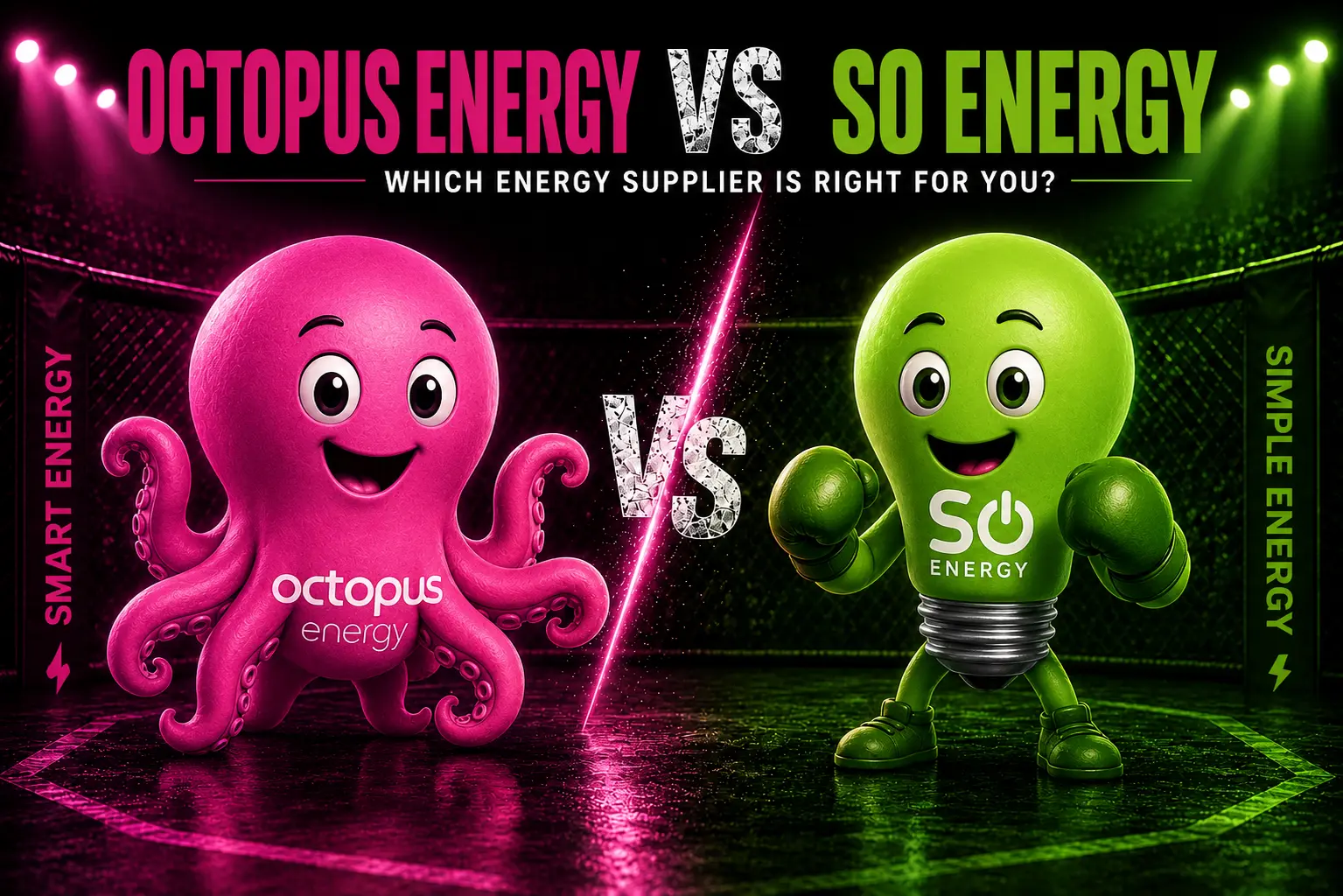
Octopus Energy vs So Energy both compete for UK households that want competitive prices, renewable electricity and modern account management. However, they serve different types of customers. Octopus is the larger, technology-led supplier, with advanced tariffs for electric vehicles, heat pumps, batteries, solar panels and customers willing to follow wholesale prices. So Energy offers a simpler range built around renewable fixed deals, a price-cap tracker, an EV tariff and personalized time-of-use pricing.
Octopus passed eight million UK customers in April 2026, while So Energy supplies more than 300,000 homes and operates with backing from ESB Energy.
This comparison examines pricing, fixed tariffs, smart plans, EV charging, renewable electricity, customer service, apps, solar export, business suitability and overall value.
Table of Contents
Quick Comparison: Octopus Energy VS So Energy
| Feature | Octopus Energy | So Energy | Winner |
| Pricing | Flexible, Tracker and Agile | Flex and Green Tracker | Depends |
| Fixed terms | Mainly twelve months | Twelve to twenty-four months | So Energy |
| Smart tariffs | Wide specialist range | So Unique | Octopus |
| EV charging | 8p, six hours | 6.5p, five hours | Depends |
| Service score | 3.67 out of 5 | 2.86 out of 5 | Octopus |
| Overall | Best for smart users | Best for simple green fixes | Octopus |
Rates and availability vary by postcode, meter, payment method and usage. Obtain personalized quotes before switching.
1. Pricing
From 1 July to 30 September 2026, Ofgem’s energy price cap is £1,862 a year for a typical dual-fuel household paying by Direct Debit. The average capped electricity rate is 26.11p per kWh, with a 57.19p daily standing charge. The average gas rate is 7.33p per kWh, with a 29.04p daily standing charge.
The cap is not a maximum bill. Customers pay for every unit used, so high-consumption households can spend considerably more than the illustration.
Flexible Octopus is Octopus Energy’s standard variable tariff. Its prices respond to quarterly cap changes. Customers can leave without an exit fee.
Octopus Tracker is different. Electricity and gas rates change every day according to wholesale costs. It can become cheaper when markets fall, but it can rise quickly during disruption. Tracker includes a supplier price ceiling of 100p per kWh for electricity and 30p for gas, which is much higher than Ofgem’s protected rates.
So Flex is So Energy’s standard variable tariff. It follows the price cap, has no fixed contract and has no early exit fee.
So Green Tracker offers renewable electricity and is designed to remain £50 below the price cap for a typical dual-fuel household. Unlike Octopus Tracker, its prices update every three months instead of daily. It therefore offers a more predictable discount but less opportunity to benefit immediately when wholesale prices fall.
Pricing Verdict
- Octopus is better for customers comfortable with daily wholesale pricing.
- So Green Tracker is easier for customers wanting a stated cap discount.
- Standard variable customers should compare complete annual estimates.
- Tracker customers must understand that advertised savings are not guaranteed for every household.
2. Fixed Tariff Options
Fixed tariffs protect unit rates and standing charges for a defined period, but they do not fix the final bill. Consumption still determines the total amount paid.
Octopus commonly focuses on twelve-month fixed tariffs. A published May 2026 snapshot estimated its then-current fix at around £1,780 for typical use, but Octopus warned that the tariff changed regularly. That version carried a £50 exit fee for each fuel.
So Energy provides twelve, eighteen and twenty-four-month fixed plans. Its fixed tariffs include renewable electricity. Current early exit fees are £75 per fuel for a twelve-month plan and £95 per fuel for eighteen or twenty-four-month plans.
So Energy therefore gives customers more contract-length choice, while Octopus usually presents a simpler one-year decision. So longer deals may appeal to customers worried about future increases, but the larger exit fees reduce flexibility.
Fixed Tariff Verdict
- So Energy offers a wider choice of contract lengths.
- Octopus may suit customers wanting a shorter commitment.
- Compare unit rates and standing charges, not contract length alone.
- Check two separate exit fees when taking a dual-fuel tariff.
- Fixing can be poor value if market prices later fall.
3. Smart Tariffs
Smart tariffs are Octopus Energy’s strongest area. Agile Octopus changes electricity prices every thirty minutes. Tracker changes rates daily. Intelligent Octopus Go supports EV charging, Cosy Octopus targets heat-pump homes, and Flux products coordinate solar generation, battery charging and export.
These tariffs can reduce costs when customers move consumption away from expensive periods. They can also become complicated because savings depend on smart meters, compatible equipment and changing household habits.
So Energy’s main smart product is So Unique. It analyses a household’s half-hourly smart-meter data and creates personalised Peak, Off-peak and Super Off-peak periods. So Energy says customers shifting twenty percent of usage could save up to £200 annually compared with So Flex. That figure is based on modelling and should not be treated as a guaranteed saving.
So Unique is innovative, but Octopus has a broader established range covering more technologies.
Smart Tariff Verdict
- Octopus is better for EVs, heat pumps, batteries and solar homes.
- So Unique is attractive for personalized time-of-use pricing.
- Octopus offers more mature products and wider availability.
- Smart tariffs work best when households can change when they use energy.
4. EV Charging
Intelligent Octopus Go offers smart charging from 8p per kWh and six off-peak household hours from 11:30pm to 5:30am. Octopus connects to a compatible vehicle or charger and schedules charging around the customer’s required battery level and completion time.
So EV currently advertises a lower overnight rate of 6.5p per kWh between midnight and 5am. The five-hour period applies to household electricity as well as EV charging. So Energy says the tariff works with any EV and charger, although customers need a compatible smart meter.
The comparison is therefore closer than Octopus’s broader reputation suggests. So EV has a lower headline rate and simpler compatibility. Octopus provides a longer household window, automatic scheduling and deeper app integration.
EV Verdict
- Lowest advertised overnight rate: So Energy.
- Longer fixed household window: Octopus Energy.
- Best direct vehicle or charger integration: Octopus Energy.
- Best straightforward tariff for any EV and charger: So Energy.
- Compare peak prices and standing charges before choosing.
5. Renewable and Low-Carbon Electricity
Octopus reported a 100% zero-carbon fuel mix for April 2024 to March 2025. Its disclosed mix consisted of 86.4% renewable electricity and 13.6% nuclear power, with no gas or coal.
So Energy’s fixed, Green Tracker, So EV and So Unique tariffs provide renewable electricity. However, So Flex is the company’s non-green variable tariff. Customers should therefore check the exact product rather than assume every So Energy plan has identical environmental credentials.
Octopus also invests in renewable generation and uses smart tariffs to encourage consumption when cleaner electricity is plentiful. So Energy allows customers to support renewable electricity while choosing simpler fixed or tracker structures.
Green Energy Verdict
- Octopus has the stronger company-wide disclosed fuel mix.
- So Energy offers renewable electricity across most specialist tariffs.
- So Flex is not a renewable tariff.
- Octopus is stronger for customers combining tariffs with low-carbon technology.
- Both can suit customers who choose the appropriate product.
6. Customer Service
Citizens Advice rated Octopus Energy 3.67 out of 5 for January to March 2026, placing it fourth in the comparison table. So Energy scored 2.86 and ranked twelfth.
Both suppliers scored 3.6 for contact waiting time and 5 for customer commitments. The largest difference was complaints performance: Octopus scored 3.5, while So Energy scored 1.5. Octopus also performed slightly better for billing and metering.
Independent rankings should carry more weight than review-platform averages because they combine several service measures. However, results change quarterly, and individual experiences vary.
Customer Service Verdict
- Octopus is the clear current winner.
- Contact waiting-time scores are equal.
- Octopus performs substantially better for complaints.
- Customers should check the latest quarterly table before switching.
7. Apps and Digital Tools
The Octopus app combines normal account management with smart-energy controls. Customers can view bills, payments, balances, meter data, Agile prices and Tracker rates. Eligible users can manage EV charging, battery tariffs, solar export and heat-pump products.
Octopus Home Mini can provide near-live electricity information by sending smart-meter data to the app. This helps customers identify the cost of appliances and understand when consumption rises.
The So Energy app covers bills, payments, readings, balances, tariff dates, standing charges and exit fees. Customers can compare available fixed deals, follow consumption and contact support through live chat during opening hours.
So Energy’s app is effective for ordinary account management. Octopus is stronger for connected devices, live information and advanced tariffs.
Digital Verdict
- Best advanced app: Octopus Energy.
- Best for basic account management: Both suppliers.
- Best connected-device controls: Octopus Energy.
- So Energy remains suitable for customers wanting a simpler interface.
8. Solar Panels and Export
Outgoing Octopus pays a flat 12p per kWh for exported electricity. Prime Outgoing pays 16p between 4pm and 7pm and 9p at other times, while Agile Outgoing follows changing wholesale export prices. Flux tariffs coordinate battery imports and exports.
So Energy’s standard Smart Export Guarantee is available even when the customer buys imported electricity elsewhere. It also offers premium export arrangements for qualifying customers who purchase eligible solar equipment from So Energy.
The highest headline offer is not automatically the best long-term option. Customers must check the promotional period, installation cost, battery compatibility, import tariff and export restrictions.
Solar Verdict
- Octopus offers the broader export-tariff range.
- Octopus is stronger for battery optimisation and dynamic export.
- So Energy may pay more under an eligible installation promotion.
- Compare lifetime system value instead of the first-year export rate.
9. Business Energy
Octopus offers fixed business tariffs, time-of-use plans and Agile pricing linked to half-hourly wholesale costs. Shape Shifters products reward businesses that move electricity use outside the expensive evening peak. Octopus also provides export tariffs for qualifying commercial solar installations.
So Energy mainly serves domestic energy customers. Its commercial proposition focuses more on solar panels and battery systems than a broad range of business supply tariffs.
Business Verdict
- Octopus is better for business electricity supply.
- Octopus suits firms able to shift consumption.
- So Energy remains relevant for commercial solar and battery installations.
- Businesses should compare contract terms, capacity charges and consumption profiles.
10. Supplier Stability and Best Fit
Octopus Energy’s eight-million-customer scale, technology platform and international operations make it an established major supplier. So Energy is much smaller but benefits from its partnership with ESB Energy and supplies more than 300,000 UK homes.
Both have credible backing, but Octopus offers greater scale and product breadth.
Octopus Energy Is Better For
- Customers wanting Agile, Tracker or specialist smart tariffs.
- Homes with EVs, heat pumps, solar panels or batteries.
- Customers prioritising stronger independent service results.
- Businesses seeking flexible or dynamic tariffs.
- Users who enjoy detailed apps and active energy management.
So Energy Is Better For
- Customers want renewable fixed deals lasting up to two years.
- Drivers want a simple 6.5p overnight EV rate.
- Customers prefer predictable Green Tracker pricing.
- Households that do not need complex connected-energy controls.
- Solar customers receive an attractive installation package.
Final Verdict
Octopus Energy is the stronger overall supplier. It wins for smart tariffs, customer service, digital tools, solar and battery integration, business energy and total product choice.
So Energy should not be dismissed. It offers more fixed-term lengths, a simpler price-cap tracker and a highly competitive 6.5p overnight EV rate. For customers who want renewable electricity without managing complex smart products, So Energy can be the more comfortable choice.
- Best overall supplier: Octopus Energy.
- Best fixed-tariff choice: So Energy.
- Best customer service: Octopus Energy.
- Best smart tariffs: Octopus Energy.
- Lowest EV headline rate: So Energy.
- Best solar and battery ecosystem: Octopus Energy.
- Best simple renewable alternative: So Energy.
The final decision should always be based on personalized annual costs, including standing charges, peak rates, exit fees and realistic usage patterns. A specialist tariff only saves money when the household can meet its requirements and use its cheaper periods effectively.
Compare UK energy suppliers, British Gas VS Utility Wearhouse tariffs and deals to find the right option for your home.
 Energy Advisor